|
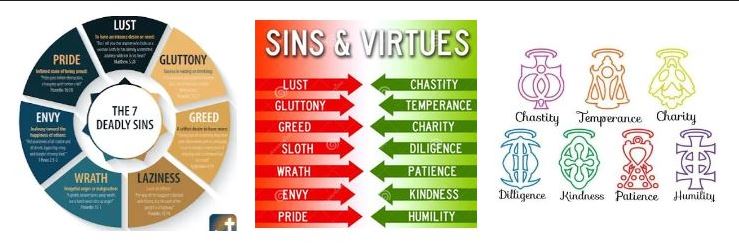
The Catechism of the Catholic Church also refers
to these sins as “capital sins” and explains why they are the most
dangerous. “Vices can be classified according to the virtues they oppose,
or also be linked to capital sins which Christian experience has
distinguished, following St. John Cassian and St. Gregory the Great. They
are called “capital” because they engender other sins, other vices. They
are pride, avarice [greed], envy, wrath, lust, gluttony and sloth” (No.
1866).
1. Pride: an excessive love of self or the desire to be better or more
important than others. “Respect for the human person proceeds by way of
respect for the principle that ‘everyone should look upon his neighbor
(without exception) as “another self,” above all bearing in mind his life
and the means necessary for living it with dignity’” (No. 1931).
2. Lust: an intense desire, usually for sexual pleasure, but also for
money, power or fame. “The God of promises always warned man against
seduction by what from the beginning has seemed ‘good for food … a delight
to the eyes … to be desired to make one wise’” (No. 2541).
3. Gluttony: over consumption, usually of food or drink. “The virtue of
temperance disposes us to avoid every kind of excess: the abuse of food,
alcohol, tobacco or medicine” (No. 2290).
4. Greed: the desire for and love of possessions. “Sin … is a failure in
genuine love for God and neighbor caused by a perverse attachment to
certain goods” (No. 1849).
5. Sloth (or Acedia): physical laziness, also disinterest in spiritual
matters or neglecting spiritual growth. “Acedia or spiritual sloth goes so
far as to refuse the joy that comes from God and to be repelled by divine
goodness” (No. 2094).
6. Anger or wrath: uncontrolled feelings of hatred or rage. “Anger is a
desire for revenge … The Lord says, ‘Everyone who is angry with his
brother shall be liable to judgment’” (No. 2302).
7. Envy: sadness or desire for the possessions, happiness, talents or
abilities of another “Envy can lead to the worst crimes. ‘Through the
devil’s envy death entered the world’” (No. 2553). |
|
Temperance
The ability to exercise moderation and
self-restraint, and to remain focused on a goal
Charity
Considered by Thomas Aquinas to be "the friendship of man for God" and
"the most excellent of the virtues"
Diligence
The effort to do one's part while keeping faith and reliance in God
Fortitude
A cardinal virtue that is also one of the seven gifts of the Holy Spirit
Prudence
Considered by some to be one of the greatest virtues, as justice,
temperance, courage, faith, hope, and charity would not be possible
without it
Faith
A theological virtue that orients us to God
Hope
A theological virtue that orients us to God
The seven virtues are said to point Christians toward God and away from
sin. Cultivating these virtues is expected to result in good works, such
as feeding the hungry, visiting the sick, and sheltering strangers
The Seven Holy Virtues
Three Spiritual (or Theological) Virtues
1. Fides (Faith)
2. Spes (Hope)
3. Caritas (Charity)
The Four Cardinal (or Pagan) Virtues
4. Prudence
5. Temperance
6. Fortitude
7. Justice |